
Many adults reach a point where they begin to question their relationship with food.
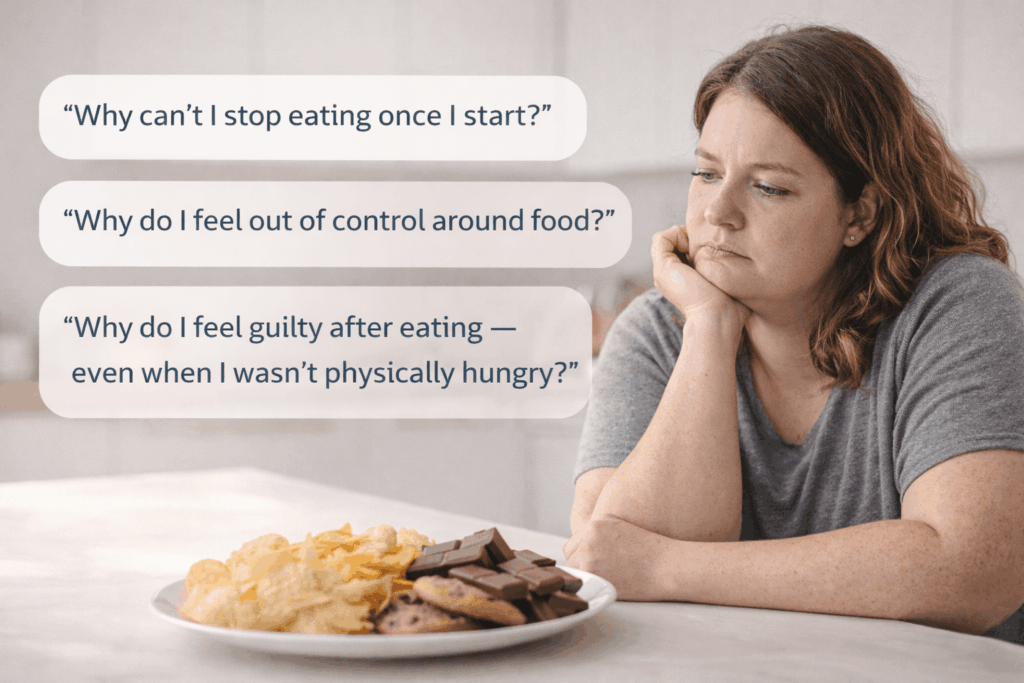
You may find yourself wondering:
- “Why can’t I stop eating once I start?”
- “Why do I feel out of control around food?”
- “Why do I feel guilty after eating — even when I wasn’t physically hungry?”
If this feels familiar, you are not alone. For many individuals, these experiences are not simply a matter of willpower. They can feel confusing, frustrating, and, at times, overwhelming.
You may have attempted to manage these patterns through dieting, structure, or renewed efforts to “start fresh,” only to find that the same cycle continues.
In some cases, these patterns may be consistent with binge eating disorder, a common and often under-recognized condition.
This guide outlines:
- what binge eating disorder is
- common signs and symptoms
- factors that contribute to these patterns
- when it may be appropriate to seek professional support
What Is Binge Eating Disorder?
Binge eating disorder is a clinically recognized eating disorder characterized by recurrent episodes of binge eating, accompanied by a sense of loss of control.
A binge eating episode typically involves:
- eating an objectively large amount of food within a discrete period of time
- experiencing a feeling of being unable to stop or control eating
These episodes are often associated with:
- eating more rapidly than usual
- eating beyond physical fullness
- eating when not physically hungry
- eating alone due to embarrassment
- marked distress following the episode
Unlike some other eating disorders, binge eating disorder is not regularly associated with compensatory behaviors such as purging, fasting, or excessive exercise.
Binge eating disorder can affect individuals across all body types, genders, and life stages, and is among the most prevalent eating disorders in adults.
Signs and Symptoms of Binge Eating Disorder
Binge eating disorder symptoms can vary in presentation and severity, but commonly include a combination of behavioral and emotional features.
Common signs include:
- recurrent episodes of eating large quantities of food in a relatively short period
- a sense of loss of control during eating episodes
- eating in the absence of physical hunger
- eating more quickly than usual
- eating in secrecy or isolation
- experiencing guilt, shame, or distress after eating
Many individuals also experience a recurring cycle:
- attempts to restrict intake or regain control
- followed by episodes of binge eating
- followed by distress and renewed efforts to change
This cycle can become self-reinforcing over time and may be difficult to interrupt without appropriate support.
What It Can Feel Like
For many individuals, the experience of binge eating is less about hunger and more about a perceived loss of control.
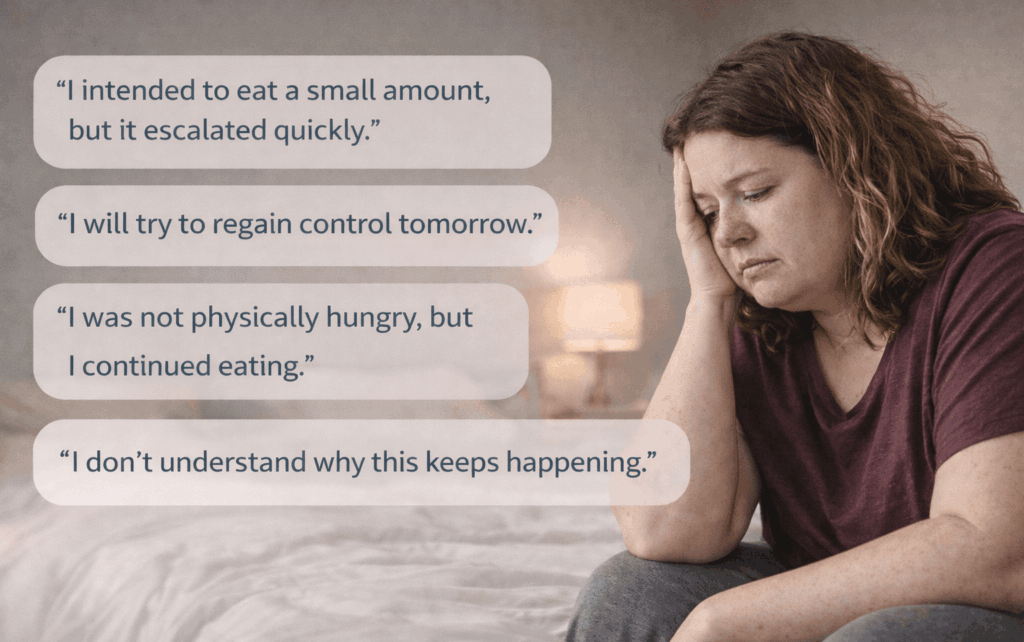
Common experiences may include:
“I intended to eat a small amount, but it escalated quickly.”
“I will try to regain control tomorrow.”
“I was not physically hungry, but I continued eating.”
“I don’t understand why this keeps happening.”
These patterns can be particularly confusing for individuals who function well in other areas of life.
This contributes to why binge eating disorder is often overlooked or misunderstood, both by others and by the individual experiencing it.
Why Does Binge Eating Occur?
Binge eating is not simply a matter of willpower. It is typically influenced by a combination of biological, psychological, and environmental factors.
Restriction and Dieting Patterns
Periods of dietary restriction can increase vulnerability to binge eating due to both physiological hunger and psychological deprivation.
Emotional Regulation
Eating may function as a coping strategy for managing distressing emotions, including stress, anxiety, or low mood.
Stress and Cognitive Load
Chronic stress or burnout can impair self-regulation and increase reliance on habitual or reward-driven behaviors.
Neurobiological Factors
Alterations in reward processing, impulse regulation, and appetite signaling may contribute to the persistence of binge eating patterns.
These factors often interact, making the behavior feel difficult to control despite repeated efforts.
Binge Eating vs Emotional Eating
Although there is overlap, binge eating disorder and emotional eating are not equivalent.
Emotional eating may involve:
- eating in response to emotional states
- a retained sense of control over intake
Binge eating disorder, by contrast, is characterized by:
- a clear sense of loss of control
- recurrent and distressing episodes
- clinically significant impact on well-being or functioning
Distinguishing between these patterns can help determine whether further assessment may be beneficial.
When Should You Consider Seeking Help?
It may be appropriate to consider an eating disorder assessment if:
- episodes feel recurrent or difficult to control
- eating patterns are associated with distress, guilt, or shame
- your relationship with food feels overwhelming or preoccupying
- patterns are affecting your emotional well-being or daily functioning
Importantly, support does not require symptoms to reach a particular threshold.
Many individuals seek assessment when they recognize that their current strategies are not effective, even if they are uncertain about the cause.
What an Assessment Can Help With
A comprehensive eating disorder assessment can provide:
- clarification regarding whether patterns are consistent with binge eating disorder
- identification of contributing psychological and behavioral factors
- validation of your experiences
- individualized recommendations for next steps
The goal is not solely diagnostic classification, but a more accurate understanding of your experience and a structured path forward.
Getting Started
If you have been questioning your relationship with food or noticing patterns that feel difficult to manage, seeking clarity can be an important step.
Lynch NP Services offers comprehensive, evidence-based eating disorder assessments for adults across Ontario, delivered through secure virtual care.
If you would like to explore whether an assessment may be appropriate for you:
Book your eating disorder assessment through our online portal